
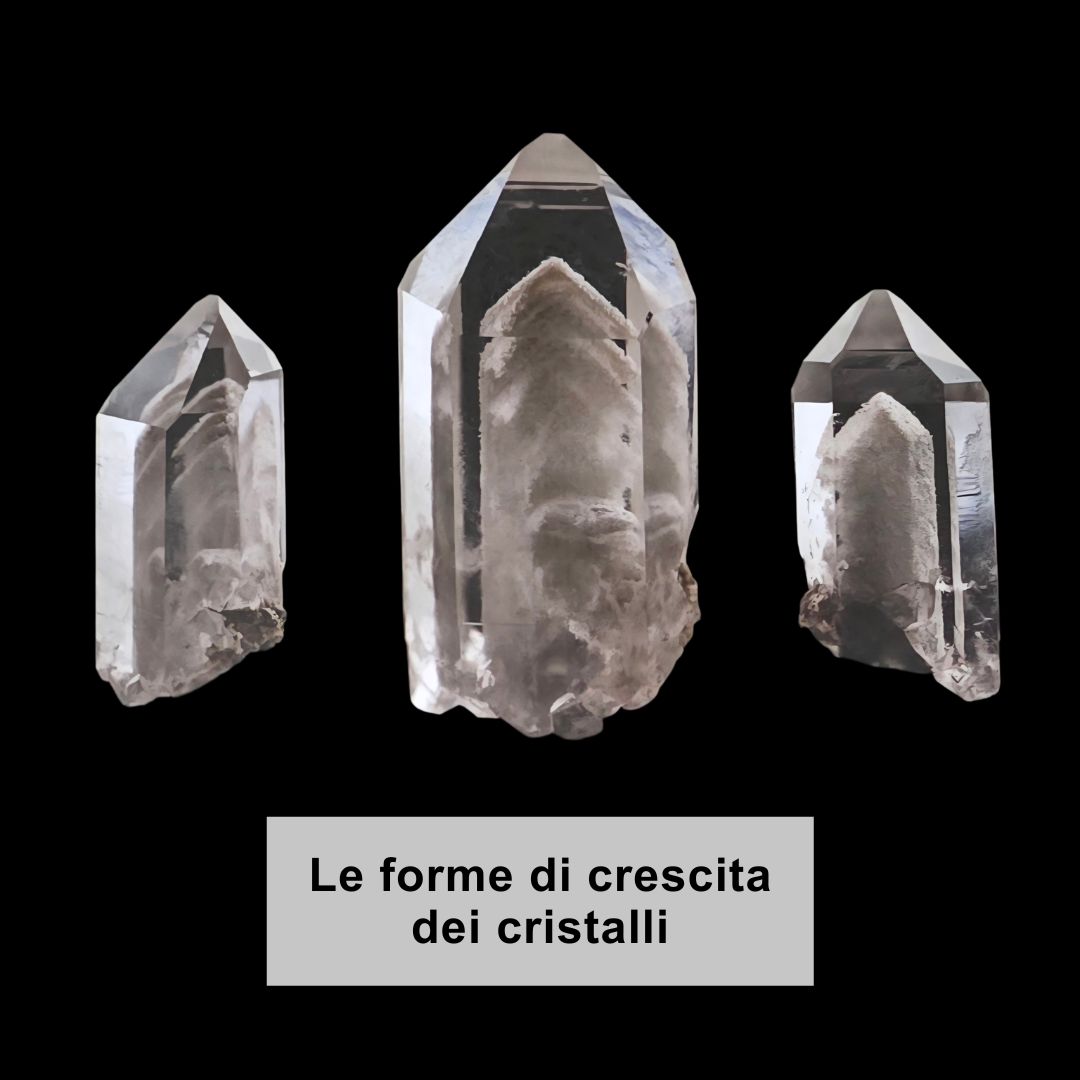
Growth forms of crystals
Crystals are not just beautiful natural elements: they are living mineral structures that form according to precise laws of growth, geometry, and energy. Every crystal shape tells a story about the conditions in which it was born, the time it needed to develop, and the environment that shaped it.
Understanding the growth forms of crystals allows you to choose them with greater awareness, both from a mineralogical perspective and in crystal healing practice. Because in crystallotherapy, shape is never just aesthetic — it influences how energy is expressed and directed.
How Crystals Grow
Crystals form when a mineral solution — often rich in silica or other elements — begins to cool and solidify. Atoms arrange themselves in ordered, repeating patterns, creating what we call a crystalline structure.
Growth can occur in open cavities, fractures, hydrothermal veins, or volcanic environments. Depending on available space, temperature, pressure, and chemical composition, the crystal may develop freely, attach to a matrix, or merge with other crystals.
When space is abundant, crystals tend to develop complete and well-defined faces. When space is limited, they adapt, creating contact points, partial terminations, or clustered formations.
This is where the fascinating variety of crystal growth forms begins.
Single-Terminated Crystals
A single-terminated crystal has one natural point at the top, while the base is attached to a matrix or rock.
This is one of the most common growth forms, especially in Quartz. The energy in crystal healing is considered to move from the base toward the tip, making it ideal for directing intention, focusing energy, and channeling work during meditation.
Double-Terminated (Biterminated) Crystals
A double-terminated crystal has two natural points, one on each end. This means it grew freely, suspended or unattached, allowing both ends to develop symmetrically.
In crystallotherapy, double-terminated crystals are associated with energy flowing in both directions. They are often used for balance work, energy exchange, and connection between two points — whether physical, emotional, or spiritual.
It is important to note that a true double-terminated crystal has both terminations formed naturally, not cut or polished.
Laser Crystals
Laser crystals are a particular type of Quartz characterized by a long, slender body and a sharp, precise termination. The sides often show subtle horizontal lines, evidence of their natural growth process.
Their name comes from their resemblance to a laser beam: in crystal healing, they are believed to focus and direct energy in a highly concentrated way.
They are commonly used for precise energetic work, clearing blockages, or directing intention toward a specific area.
Capped (Scepter) Crystals
Capped crystals, also known as scepter crystals, form when a second crystal grows over the tip of an existing one, creating a “cap” or crown-like structure.
This happens when growth conditions change and a new phase of mineral deposition occurs. The base crystal forms first, then a new crystal layer develops on top, often larger in diameter than the original shaft.
Energetically, they are associated with transformation, authority, and the evolution of consciousness — symbolizing growth in stages.
Cluster Formations
Crystal clusters form when multiple crystals grow together from the same matrix. Each point develops in its own direction, yet remains connected at the base.
In mineralogical terms, this happens when many nucleation points are present in the same environment. In crystal healing, clusters are often used to harmonize spaces, as they radiate energy outward in multiple directions simultaneously.
Why Growth Forms Matter in Crystal Healing
In crystallotherapy, the shape of a crystal influences how energy is perceived and directed. A pointed crystal focuses, a sphere radiates evenly, a cluster diffuses, a double-terminated crystal connects.
While mineral composition determines the intrinsic properties of the crystal, growth form shapes how those properties are expressed.
Understanding growth forms allows you to choose not only the right mineral, but also the most suitable structure for your intention.
Final Thoughts
Crystals are the result of time, pressure, chemistry, and space working together in perfect geometric harmony. Every growth form is a natural response to environmental conditions — and each carries a unique energetic signature.
By learning to recognize and understand these forms, you deepen your relationship with the mineral world. You move beyond simple aesthetic appreciation and begin to see crystals as dynamic structures shaped by Earth’s intelligence.
Whether you are drawn to a single-terminated Quartz, a double-terminated crystal, a laser formation, or a precisely cut Vogel, knowing how and why it formed allows you to work with it more consciously.
Because in the end, growth form is not just about how a crystal looks. It is about how it came into being — and how it interacts with your energy.