
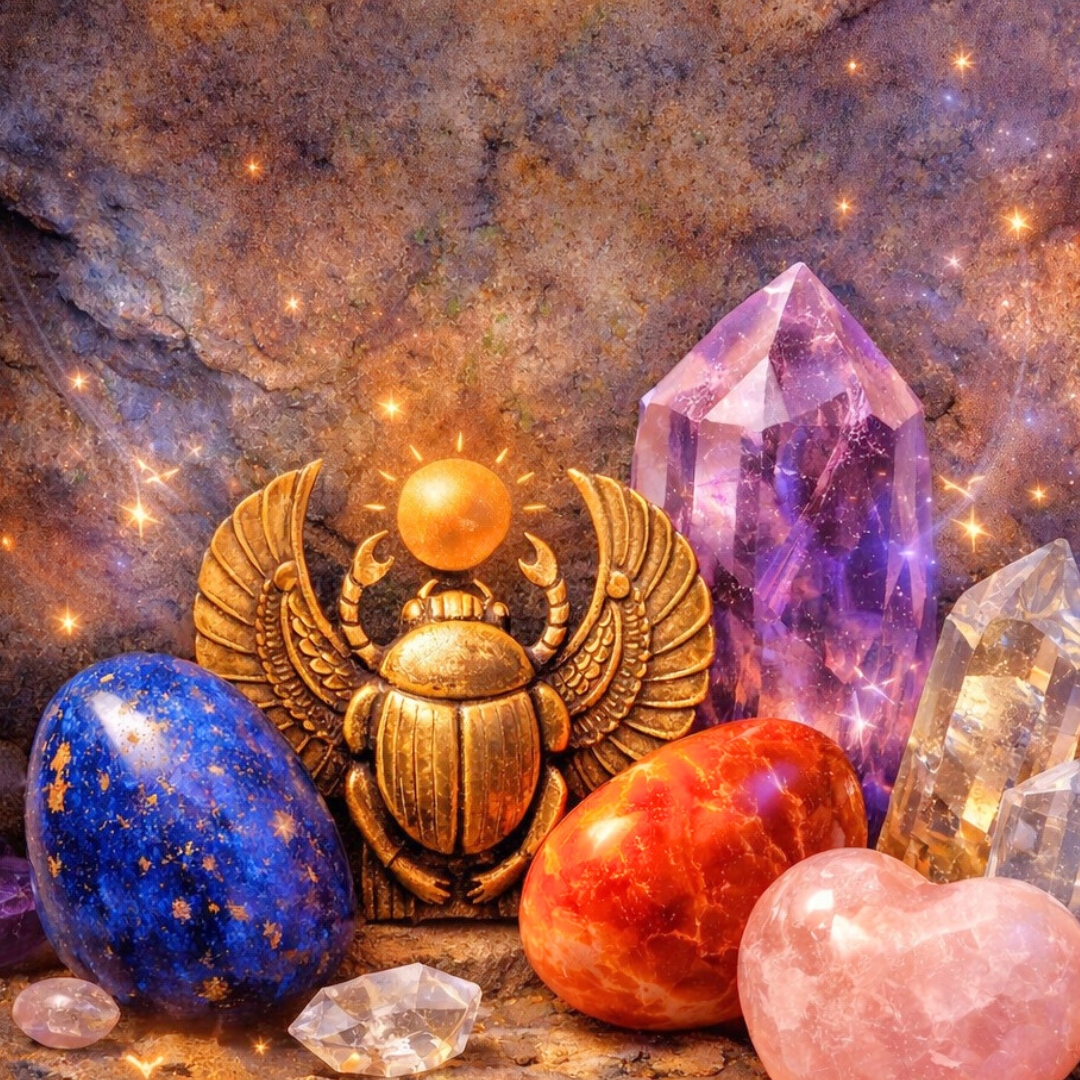
Amulets and talismans: the symbolic power of stones throughout history
Before they became jewellery to wear, collect or give as gifts, stones were symbols of protection, identity and power.
They accompanied men and women throughout their lives, on journeys, during religious ceremonies and even after death. They were set into rings, placed among the wrappings of mummies, engraved with divine images or incorporated into objects used for prayer.
They were not merely decorative.
Depending on the culture and historical period, stones were believed to possess protective, healing, auspicious or spiritual qualities. Their colour, rarity, origin and durability made them special materials, capable of distinguishing their owners and representing something that went beyond beauty alone.
Some amulets were also connected to women’s lives, particularly pregnancy, childbirth, fertility and the protection of children. However, the relationship between women and stones was not exclusive: amulets and talismans were also used by men, soldiers, rulers, priests, merchants and children.
Exploring this history means entering a world shaped by religion, magic, ancient medicine, social status and the human need for protection.
It also means distinguishing what we know from archaeological evidence from later interpretations and the associations promoted by modern crystal healing.
What is the difference between an amulet and a talisman?
The words amulet and talisman are often used interchangeably. In reality, they describe two slightly different concepts, although their functions have frequently overlapped throughout history.
An amulet is generally an object worn, carried or kept in a particular place because it is believed to ward off danger. It might be used as protection against misfortune, illness, negative influences or supernatural forces.
A talisman, by contrast, was often created, engraved or consecrated to encourage a particular outcome. It could be associated with good fortune, love, prosperity, victory or personal success.
The distinction, however, is not absolute. In many cultures, the same object could simultaneously protect its owner, attract good fortune and express their identity or social position.
Almost any object could become an amulet when a person or community believed that it had the power to influence what happened around them.
The material alone did not therefore make an object an amulet. Its shape, the image engraved upon it, the words spoken over it, the ritual performed and, above all, the belief of the person using it were equally important.
Why were stones chosen?
Stones possess qualities that must have appeared extraordinary since ancient times.
Some emerge from the earth with intense colours. Others reflect the light, display unusual veins or remain visibly unchanged for centuries.
A rare stone brought from a distant land could also testify to the existence of extensive trade routes and communicate the prestige of the person able to obtain it.
Their durability made stones particularly suitable for representing ideas such as:
- eternity;
- strength;
- stability;
- protection;
- rebirth;
- closeness to the divine.
However, not everything commonly described as a “stone” is mineralogically the same.
Lapis lazuli, for example, is not a single mineral but a rock composed mainly of lazurite, calcite and pyrite. The small golden inclusions often visible within it are generally crystals of pyrite.
The term jade does not refer to a single mineral species either. In gemmology, it is used primarily for nephrite and jadeite, two materials with different compositions and structures.
These distinctions do not diminish the appeal of stones. On the contrary, they allow us to understand and describe them more accurately and authentically.
Stones in Ancient Egypt: protection in life and the afterlife
In ancient Egypt, amulets accompanied both the living and the dead.
They could represent animals, deities, parts of the body, religious symbols or objects from everyday life. They were made from stone, metal, glass, Egyptian faience, shell, wood and organic materials.
According to Egyptian beliefs, some of these objects protected their wearers during life. Others were placed among the wrappings of mummies to safeguard the body and encourage the regeneration of the deceased in the afterlife.
Lapis Lazuli and Carnelian
Lapis lazuli was valued for its intense blue colour and rarity. It reached Egypt through long-distance trade networks, and its colouring could evoke the sky, the night and the divine realm.
Carnelian, an orange-red variety of chalcedony, could instead suggest blood, warmth, vital energy and protection.
These associations were not simply “properties of the stone”. They depended on its colour, the form of the object, its religious context and the position in which the amulet was placed.
The Eye of Horus
One of the best-known symbols is the wedjat, commonly called the Eye of Horus.
According to the myth, the eye of the god Horus was injured during his conflict with Seth and later restored. The symbol therefore came to evoke restored wholeness, symbolic healing, regeneration and protection.
The Eye of Horus was used by the living and also included in funerary assemblages. It was not a cure in the modern medical sense, but a religious symbol representing the restoration of order after destruction.
The scarab and renewal
The scarab was another of the most widespread amulets.
It was associated with Khepri, a manifestation of the rising sun. The movement of the dung beetle as it pushed a ball across the ground was linked to the sun’s daily journey and continual rebirth.
Scarabs could be worn as amulets, used as seals or placed in funerary assemblages. Their meaning evoked renewal, transformation and the possibility of new life.
Protecting women during childbirth
Some Egyptian amulets were closely associated with women’s experiences.
The goddess Taweret, depicted with human features combined with those of a hippopotamus, lion and crocodile, was believed to protect women during pregnancy and childbirth. Her image appeared on amulets and ritual objects intended to safeguard both mother and child.
Her appearance could seem threatening, yet it was precisely this strength that made her an effective protector. The features of several dangerous animals were brought together in a figure believed capable of frightening away danger.
Greece and Rome: gems, identity and destiny
In the Greek and Roman worlds, gems formed part of everyday, political and religious life.
They were mounted in rings, pendants and other pieces of jewellery, but could also be engraved with images of deities, animals, portraits, astrological symbols and formulas believed to offer protection.
Not every gem carried a magical meaning. Many were chosen simply for their beauty, economic value or ability to communicate social prestige.
Did Amethyst Really Protect against Drunkenness?
One of the best-known beliefs concerns amethyst.
Its name derives from the Greek améthystos, a word connected to the idea of being “not drunk” or “not intoxicated”. In the ancient world, the belief developed that this purple variety of quartz could protect against drunkenness and preserve mental clarity.
This was a belief, not a scientifically demonstrated effect.
Amethyst does not neutralise alcohol or prevent intoxication. Its association with clarity belongs to the cultural and symbolic history of the gemstone.
Engraved gems and signet rings
Engraved gems also served a highly practical purpose.
When mounted in a ring, they could be pressed into wax or clay to leave an impression. The seal identified its owner, authenticated documents, secured containers or communicated personal and political authority.
In antiquity, engraved gems bearing personal or official emblems could therefore function as a genuine signature.
Some depicted deities or mythological figures. Others were engraved with formulas, names and images connected to Greco-Roman magic, particularly during the Roman imperial period and Late Antiquity.
In such cases, the stone was not merely decorative. It became a personal object in which image, material and written word were combined to offer symbolic protection.
The middle ages and the powers described in lapidaries
During the Middle Ages, knowledge about stones was collected in texts known as lapidaries.
These works described the appearance, origins and qualities of gems, combining natural observations with ancient medicine, religion, astrology, travel accounts and magical beliefs.
They were not mineralogical manuals in the modern sense. Rather, they reflected the ways in which medieval societies attempted to interpret the natural world.
The rarity of gemstones and the difficulty of reaching the lands from which they came contributed to the growth of marvellous stories. Emeralds, rubies, sapphires and amethysts were consequently attributed protective, moral and curative powers.
The emerald could be regarded as a remedy against poison. The ruby was associated with strength, vitality or protection. Because of its colour, the sapphire could evoke the heavens, purity and the spiritual realm.
These meanings were not always consistent. They varied according to the text, author, period and geographical area.
It is also important to remember that the names found in ancient and medieval sources do not always correspond to modern gemmological classifications. A stone described as sapphirus or carbunculus in a manuscript cannot automatically be identified as the sapphire or ruby recognised by gemmologists today.
Stones, reliquaries and astrology
Gemstones were also set into crosses, reliquaries, crowns, episcopal rings and manuscript covers.
Their value was not purely economic. Their light, colour and durability could express the precious nature of the sacred and the authority of the person or institution that owned the object.
Astrological practices connected to the preparation of talismans also circulated in certain environments. A gemstone might be engraved with a planetary image at a moment considered astrologically favourable, with the aim of attracting protection or good fortune.
This was not, however, a practice shared uniformly by medieval society. Religion, astrology and magic existed in a complex relationship that was not always free from tension or opposition.
Jade in Chinese History
Few materials have held a cultural importance comparable to that of jade in Chinese history.
As early as the Neolithic period, it was worked into ceremonial objects, ornaments and symbols of prestige. Perforated discs known as bi, which have often been discovered in burials, are among the most recognisable examples.
Many of these early objects were made from nephrite, the material that dominated Chinese jade culture for thousands of years. Jadeite, which is now highly valued in the gem trade, became widespread in China at a much later date.
The rarity of the material and the complexity of working it made jade objects indicators of wealth and social status. During the Shang and Zhou dynasties, they were also used in offerings to deities and ancestors, funerary rituals, court ceremonies and the symbolic recording of agreements between states.
Over time, jade also became associated with moral virtues such as righteousness, wisdom, integrity and benevolence.
It was not simply a stone believed to “bring balance”. It was a material embedded within a complex system of ritual, political power, philosophy, social status and relationships with the ancestors.
Speaking generically about “Eastern traditions” risks erasing the differences between cultures that are geographically and historically distant from one another. The meaning of jade in China cannot automatically be extended to India, Tibet, Japan or other Asian societies.
India: the nine gems and their relationship with the heavens
Gemstones hold a particular role within Indian astrological traditions.
One of the best-known examples is the Navaratna system, a Sanskrit term meaning “nine gems”. Each gemstone is associated with a celestial body or astrological force.
The traditional group comprises ruby, pearl, red coral, emerald, yellow sapphire, diamond, blue sapphire, hessonite garnet and chrysoberyl cat’s eye.
These nine gems are connected to the Sun, Moon, five planets visible to the naked eye and the two lunar nodes known as Rahu and Ketu. Together, they could form pieces of jewellery with astrological, religious and talismanic significance.
Here too, however, the wording must be precise.
Gemstones do not scientifically alter the movement of the planets or neutralise demonstrable cosmic influences. Their use belongs to an astrological and spiritual tradition.
Japa Mala: Beads That Accompany Prayer
Within Hindu and Buddhist traditions, we also find japa malas, strings of beads used to count repetitions of mantras, prayers and devotional formulas.
The Sanskrit word japa refers to meditative recitation or repetition, while mala means garland.
Many malas consist of 108 beads, although versions with different numbers also exist. In Tibetan Buddhist traditions, the beads allow practitioners to keep count of their recitations, while the number 108 carries a range of ritual and symbolic meanings.
Malas can be made from many different materials:
- wood;
- seeds;
- bone;
- mother-of-pearl;
- coral;
- ornamental stones;
- pearls;
- other plant-based materials.
One of the best-known is rudraksha, which is not a stone. It is a seed that has been used for centuries to create prayer beads.
Today, malas made from amethyst, rose quartz and other ornamental stones are also very common. However, the associations between rose quartz and love, or between amethyst and calm, derive primarily from modern crystal healing and contemporary holistic spirituality.
They should not therefore be presented automatically as beliefs belonging to ancient Indian tradition.
Amulets and female identity
The relationship between amulets and women’s lives deserves attention, but it should not be described as a universal rule.
In many societies, pregnancy and childbirth were particularly vulnerable moments. The medical knowledge and forms of assistance available today did not exist, and the risks for both mother and child were extremely high.
Rituals, formulas and amulets offered a form of symbolic protection in the face of an event that could not be fully controlled.
In ancient Egypt, the goddess Taweret protected pregnancy and childbirth. In Mesopotamia, amulets depicting figures such as Pazuzu were used to defend mothers and newborn babies against the demon Lamashtu, who was believed to threaten pregnant women and infants.
These objects tell us about genuine fears, but also about the need to entrust hope to something tangible.
A stone, pendant or small figure could be touched, worn and passed down. It became a fixed point in a moment of uncertainty.
Not all amulets associated with women were connected to motherhood. Jewellery and gemstones could also express wealth, authority, family identity, religious devotion and personal taste.
The relationship between women and stones does not therefore arise from the idea of an inherently “more intuitive feminine nature”. It emerged from a wide variety of historical, social and personal experiences.
From the ancient talisman to the stones we choose today
Even today, many people do not choose a stone purely for its colour.
They choose it because it reminds them of someone, represents an important moment or expresses an intention. It may become a symbol of a new beginning, desired protection or a quality that the wearer wishes to cultivate.
Symbolic value does not need to be presented as a scientific property in order to be meaningful.
An inherited piece of jewellery can make us feel close to the person who wore it before us. A stone purchased during a journey can preserve the memory of that place. An amulet given as a gift can represent the affection and care of the person who chose it.
In these cases, the power does not necessarily reside in the mineral itself. It grows from the story we connect to the object.
Crystal healing, symbolism and scientific evidence
Modern crystal healing attributes energetic, emotional and spiritual qualities to stones.
According to this tradition, for example, amethyst is associated with calm, rose quartz with the emotional and romantic sphere, and carnelian with vitality.
These associations can be described as part of a holistic and symbolic practice. They should not, however, be confused with demonstrated mineralogical properties or with medical and psychological treatments.
A controlled study published in 2025 found no specific effects of crystals on anxiety beyond those associated with a placebo. The changes perceived by participants appeared to be linked primarily to expectations and to the context in which the experience took place.
This does not mean dismissing the personal value of a ritual.
Holding a stone during meditation may help someone pause, focus or remember a personal intention. However, that benefit does not demonstrate the existence of an intrinsic therapeutic energy within the mineral.
For this reason, we prefer to use clear expressions such as: "According to crystal healing, this stone is associated with..." or "On a symbolic level, it represents..."
Describing stones responsibly also means being honest about the limits of the available evidence.
Stones have never been merely objects
From the Eye of Horus to Roman engraved gems, from medieval lapidaries to Chinese jade, stones have travelled through civilisations, religions and centuries.
They have not always carried the same meaning. They have not been used in the same way, and they cannot be reduced to a single idea of spirituality.
They have been ornaments, seals, offerings, symbols of power, instruments of prayer and objects entrusted with human fears and hopes.
Some were believed to protect the dead during their journey into the afterlife. Others accompanied women during pregnancy, rulers during ceremonies, merchants during exchanges and worshippers during prayer.
Today, we can continue to choose a stone for what it represents to us.
We can wear it as a memory, a personal amulet or the symbol of an intention. We can appreciate its colour, geological formation and cultural history without attributing promises to it that it cannot fulfil.
Stones, after all, have never been merely objects.
They have been witnesses to human history and symbolic allies in our search for beauty, protection and meaning.